
Prothonotary Warbler Nest Box and Migration Study
Habitat Overview
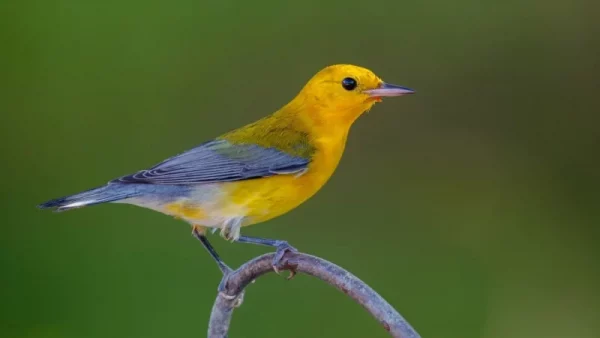
The Prothonotary Warbler (scientific abbreviation is PROW) is a small brightly colored bird known for its golden-yellow head and breast, blue-gray wings, and prominent black eyes. These birds nest in cavities in dead trees in bottomlands and wooded swamps mainly in Louisiana, Mississippi, Georgia, and South Carolina. The PROWs now travel farther north and west to nest, and we are fortunate to have them breeding in Kansas and Missouri. They overwinter in the mangrove swamps and wet lowland forests of Colombia in South America. Overall, their population is declining due to habitat loss in both breeding and wintering grounds. The population is stable (and locally on the increase) in Kansas and Missouri due to nest boxes provided by naturalists and citizen scientists.
Origins of the Local Nest Box Project
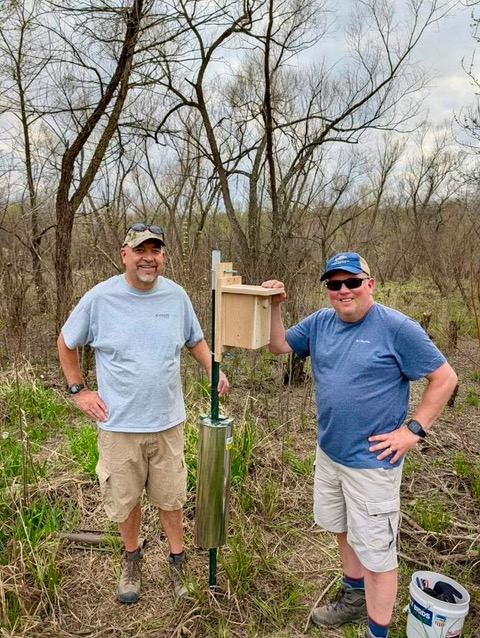
The Prothonotary Warbler Nest Box and Migration Study was started in 2022 by Johnson County K-State Extension Master Naturalists with several nest boxes in Wyandotte and Johnson Counties in Kansas. We now work with ornithology researchers at Pittsburg State University in Kansas. Our teams combined have over 300 nest boxes throughout eastern Kansas and Missouri. In 2026, our nest boxes fledged over 200 young PROWs.
Analyzing the Migration Data
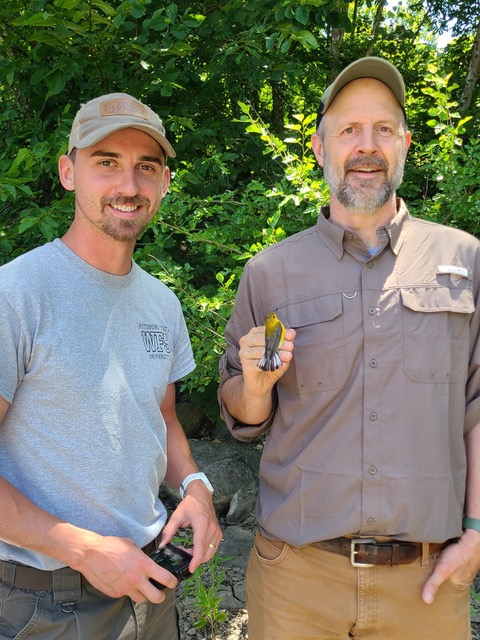
In 2026, Andy and Gabe recaptured three PROWs and removed their geolocators. The migration data from one of the PROWs named “Hydrogen” have been analyzed and are depicted in the map included in Johnson County K-State Extension Master Naturalist Heather Cwach's in-depth article about the project. Data analysis is pending for the other PROWs. The data from the migrating PROWs will inform engineers and scientists designing future wind farms for the Gulf of Mexico. The migration data will also be used by conservationists to protect PROWs on their migratory journey through the United States, Mexico, and Central America to their winter home in Colombia.