
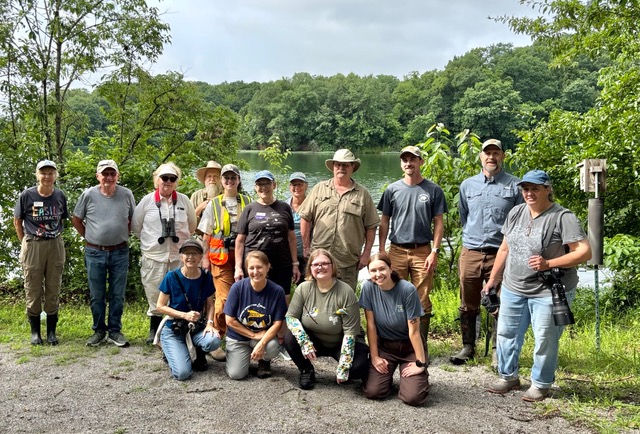
by Heather Cwach, Johnson County K-State Extension Master Naturalist
Every spring, there is a moment of anticipation.
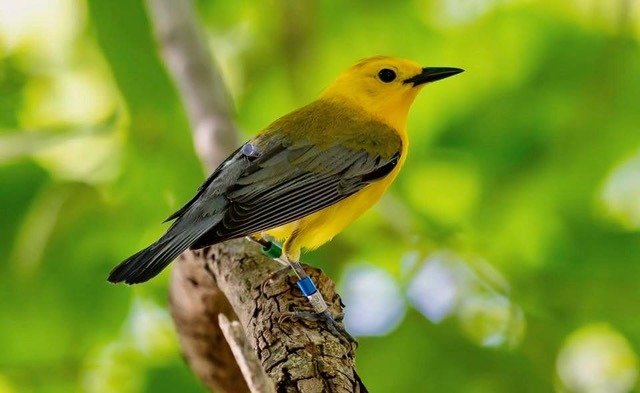
Nest boxes are opened carefully. Binoculars scan flooded woods, riverbanks, and quiet wetlands. Volunteers pause, listening for the rich, ringing sweet-sweet-sweet-sweet song echoing through the trees that often reveals a Prothonotary Warbler before it is seen. Then comes the reward: a dazzling flash of golden-yellow feathers glowing against the dark greens of the forest, earning the species its fitting nickname, the “swamp candle.”
For the Prothonotary Warbler, the journey back to eastern Kansas is nothing short of extraordinary. Weighing barely half an ounce, these brilliant golden songbirds have crossed the Gulf of Mexico, flown through Central America, and traveled more than 2,000 miles from their wintering grounds in South America to nest once again in the wetlands they call home.
For the Johnson County K-State Extension Master Naturalists, Burroughs Audubon Society of Greater Kansas City, and the many partners who steward this project, every returning bird represents possibility. But every so often, one represents something even greater. It represents a story.
This season marked one of the most exciting years yet for the Prothonotary Warbler research program in eastern Kansas.
Working together, volunteers and researchers celebrated something every bird bander hopes for: the return of birds that had been banded in previous years, including several that had first been banded as nestlings.
For bird banders, few moments are more rewarding than holding an adult bird and realizing it was once a tiny nestling you carefully banded the year before.
Imagine that for a moment.
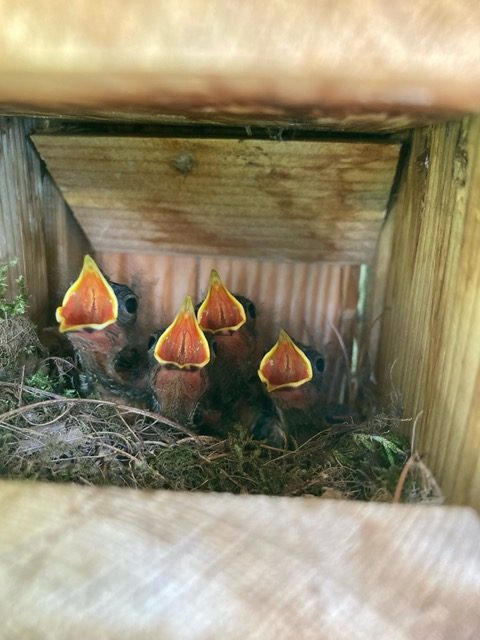
Only a year ago, these birds were gawky little fluffballs, wide-mouthed nestlings with oversized feet, wisps of down, and more personality than feathers. Within weeks they would leave the nest and begin one of nature’s most demanding migrations. Somehow, after surviving an entire year and traveling thousands of miles, they found their way back to the very wetlands where they first entered the world.
Now they had returned—not as nestlings, but as adults establishing nests of their own.
Soon, researchers were banding the next generation.
It is difficult not to feel a sense of wonder witnessing that cycle.
Stories like these do not happen because of one researcher or one organization. They happen because an extraordinary community comes together around a shared passion for birds and conservation.
This project brings together volunteers from the Johnson County K-State Extension Master Naturalist program, members of Burroughs Audubon Society, researchers from Pittsburg State University, conservation partners, local land managers, photographers, and dedicated citizen scientists who spend countless hours monitoring nest boxes throughout eastern Kansas.
Each person contributes something essential.
Some build and maintain nest boxes.
Some scout locations, install boxes, and carefully maintain those boxes and monitor nests throughout the breeding season.
Some record observations that become valuable long-term data.
Others band birds, deploy geolocators, analyze migration information, and ask the scientific questions that help us better understand this remarkable species.
No single person could accomplish this work alone. Each role may seem small on its own, but together they create something extraordinary. A volunteer checking a nest box makes it possible for researchers to recover a geolocator. A photographer documenting the process helps tell the story to the public. A land manager protecting habitat ensures the birds have a place to return. Birders sharing information and contributing to eBird help the researchers find the banded birds. Every contribution matters because no single person could accomplish this work alone.
Together they are building one of the most detailed pictures yet of Prothonotary Warbler migration and breeding ecology in our region. That collaboration translated into one of the most productive field seasons the project has experienced.
Under the leadership of Dr. Andy George and Pittsburg State University Graduate Teaching Assistant Gabe McClain, researchers:
- Placed colorful study bands on 43 new adult Prothonotary Warblers
- Deployed 36 geolocators on adult birds
- Recaptured 18 adults previously banded in earlier years. Including four birds that had originally been banded as nestlings
- Placed federal bands on 117 nestlings, each representing another opportunity to better understand future migration and survival
Every one of those numbers represents careful teamwork in the field, countless volunteer hours, and another opportunity to learn from a species that still holds many mysteries.
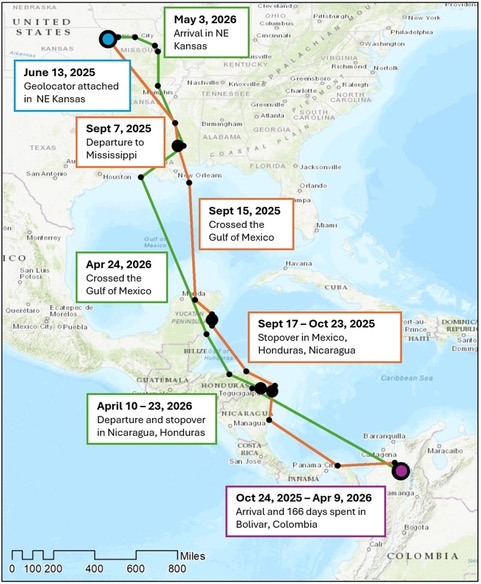
Among this year’s most exciting moments was the recovery of geolocator data from a bird affectionately known as Hydrogen.
For the first time, the invisible became visible.
The tiny tracking device revealed an astonishing journey from northeastern Kansas through Mississippi, across the Gulf of Mexico, through Central America, and ultimately to Colombia before making the return trip to nest once again in Wyandotte County Lake Park.
More than 2,000 miles each way.
For a bird weighing less than a handful of paper clips, the accomplishment borders on unbelievable.
Additional stories are still waiting to be told.
Geolocators recovered from Mulberry, a Prothonotary warbler recaptured at Wilderness Wetlands in Johnson County, and Patches, another Prothonotary Warbler from southeastern Kansas will soon be sent to the manufacturer in Europe so researchers can retrieve their stored migration data. Those maps promise to add even more chapters to the story of these remarkable travelers.
As remarkable as these discoveries are, they also remind us of an important truth.
Conservation does not stop at county lines, or even national borders.
Nearly 90 percent of Prothonotary Warblers spend the winter in Colombia, meaning the future of the species depends on healthy habitat thousands of miles from where they nest in Kansas.
The birds we celebrate each spring in Kansas spend most of the year in another country. Their future depends upon people living thousands of miles away, people who care just as deeply about this tiny golden bird as we do. That reality has led to an exciting new chapter for the program.
Burroughs Audubon Society and the Prothonotary Warbler project have been selected as one of the first three participants in a National Audubon Society partnership with with Latin America. Burroughs Audubon Society has been paired with the coastal city of Barranquilla, Colombia to learn more about this beloved bird.
Supported by Burroughs Audubon Society and a grant from the National Audubon Society, this collaboration will allow communities separated by thousands of miles but connected by one extraordinary bird to learn from one another and strengthen conservation efforts throughout the warbler’s annual journey.
The next time you hear the bright, piercing song of a Prothonotary Warbler echoing through a Kansas wetland, consider everything that bird has experienced.
It has crossed continents and oceans. It has survived storms, predators, and thousands of miles of migration. It has returned with remarkable precision to the same flooded woods where it once hatched.
And waiting here are volunteers, researchers, birders, students, and conservationists ready to welcome it back. Not simply because they love birds, but because every returning warbler reminds us that conservation is built through partnership.
There is something profoundly hopeful about a Prothonotary Warbler. In a world that often feels increasingly fragmented, this tiny bird reminds us that wetlands, forests, universities, libraries, conservation organizations, volunteers, photographers, and communities separated by thousands of miles are all connected by a single thread. Every spring, that thread returns to Kansas on golden wings.
From a nest box in Kansas to classrooms at Pittsburg State University, from volunteers, photographers, and citizen scientists wading through flooded wetlands to researchers analyzing migration data, and from the woodlands of Kansas to the Caribbean coast of Colombia, each person holds a single piece of an extraordinary story. The Prothonotary Warbler may make the journey alone, but its future depends on all of us.
Whether you monitor a nest box, plant native trees, support conservation organizations, photograph wildlife, or simply stop to appreciate a flash of golden feathers along a wooded stream, you become part of this story.